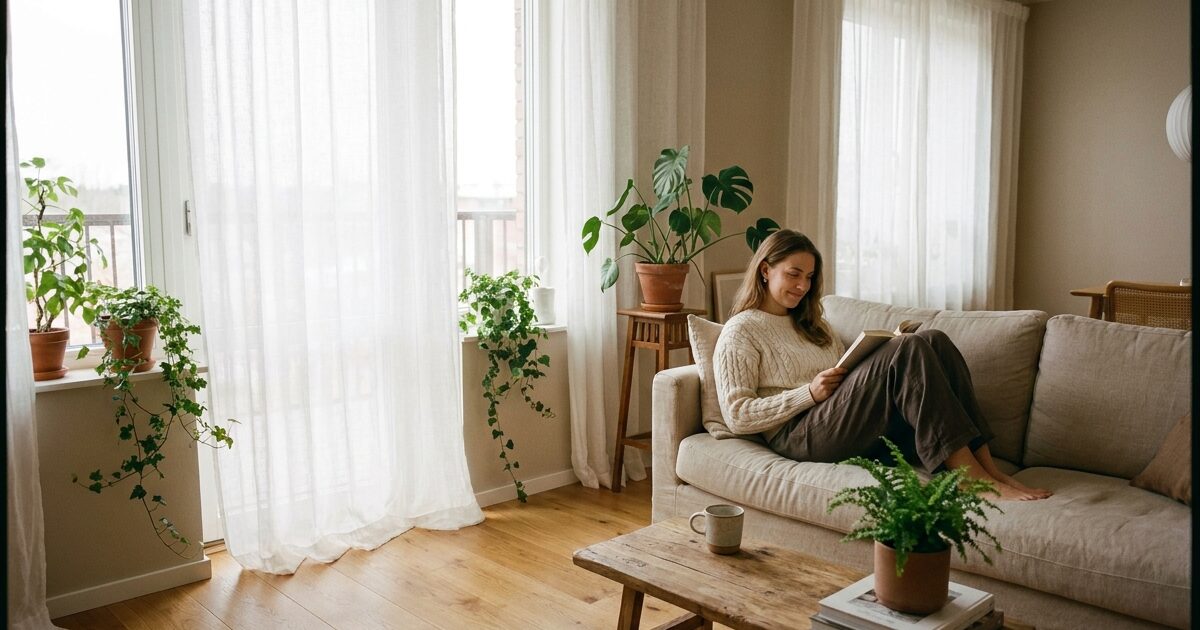
Natural light in a living room is not just a matter of taste or decoration. It affects the perceived temperature, energy consumption, and visual comfort throughout the day. French regulations, particularly RE2020, now govern how glazing and solar protections must coexist to ensure a truly pleasant living environment.
Solar factor and glazed area: what RE2020 requires for the living room
RE2020 sets two simultaneous constraints for new housing.
Article 23 mandates a total glazed area of at least one-sixth of the reference area of the dwelling. Article 24, in parallel, regulates the solar factor of the glazing to limit excessive thermal gains during hot periods.
A highly glazed living room facing south or west can therefore provide remarkable brightness in winter while becoming uncomfortably warm between June and September. Comfort does not depend on the amount of light captured, but on the ability to filter it according to the season and time of day. An roller blind installed on the interior side already reduces glare and tempers direct solar gains, but external protections remain more effective against overheating.
| RE2020 Criterion | Objective for the living room | Risk if not respected |
|---|---|---|
| Minimum glazed area (art. 23) | At least one-sixth of the reference area | Room too dark, increased reliance on artificial lighting |
| Solar factor of the glazing (art. 24) | Limit excessive solar gains | Summer overheating, thermal discomfort |
| Summer comfort indicator (DH) | Keep degree-hours below the regulatory threshold | Exceeding the regulatory threshold, resuming thermal study |

Light distribution in the living room: why consistency matters more than intensity
A sunlit living room near the window but shrouded in shadow at the back creates a contrast that the eye constantly compensates for. This visual fatigue often goes unnoticed, but it results in a diffuse discomfort by the end of the day.
The quality of natural lighting is assessed not by the brightest point in the room, but across the entire usable area. The consistency of light in the room takes precedence over its maximum intensity.
Parameters that influence distribution in a living room
- The depth of the room relative to the height of the window: the deeper the living room, the less direct light reaches the back, and the more reflection from the walls takes over.
- The color and finish of the walls and ceiling: light, matte surfaces diffuse light more evenly, while a dark wall absorbs most of the incoming light flow.
- The position and number of openings: two windows on perpendicular walls create a much more homogeneous cross-lighting than a single large bay.
- External obstructions (neighboring buildings, balconies, dense vegetation) that reduce the portion of sky visible from inside the living room.
Enlarging a bay window without addressing these parameters amounts to increasing local brightness without improving overall comfort. In some cases, a skylight or light well provides more consistency than enlarging the main bay.
Natural light and thermal comfort in the living room: the compromise to negotiate
RE2020 simultaneously evaluates lighting needs, solar gains, and discomfort during hot periods. This triptych requires thinking of natural light as a flow of energy, not just as free lighting.
An efficient glazing alone is not enough to solve the problem. Solar control double glazing reduces thermal gains but also filters part of the light spectrum. The living room loses perceived brightness in exchange for coolness. Therefore, the choice of glazing depends on orientation, local climate, and the room’s use.
Mobile solar protections: an underestimated comfort lever
Fixed protections (overhangs, horizontal sunshades) block high summer sun but allow low winter sun to pass through. Mobile protections allow for fine adjustments according to the time of day and season. External mobile protections are more effective than internal protections in limiting overheating, as they intercept radiation before it passes through the glazing.
On the other hand, interior solutions (blinds, sheers, technical curtains) still hold real value for managing glare without completely blocking the view. Visual comfort and thermal comfort do not always rely on the same device.

Colors, materials, and layout: amplifying natural light without changing the windows
When the layout of the living room is fixed (condominium, old building, limited budget), several interior levers can significantly alter the perception of brightness.
A matte white ceiling reflects more light towards the back of the room than a tinted or satin ceiling. The floor also plays a role: a light wood floor or matte-finished tiles contribute to the diffusion of incoming light flow.
Furniture placed in front of a window or a tall piece positioned perpendicular to the bay creates a direct obstacle to the light’s path. Moving the sofa back a few dozen centimeters from the window may be enough to free the passage of light flow to the center of the room.
- Favor light colors on the walls facing the windows, where reflection has the most impact.
- Avoid opaque curtains during the day: a light sheer filters glare while retaining the majority of the light flow.
- Install a mirror on the wall opposite the main window to reflect light into darker areas.
Natural light in a living room results from a balance between glazed area, orientation, solar protections, and treatment of interior surfaces. RE2020 has established this principle in regulation. It remains to apply it in every renovation or construction project.