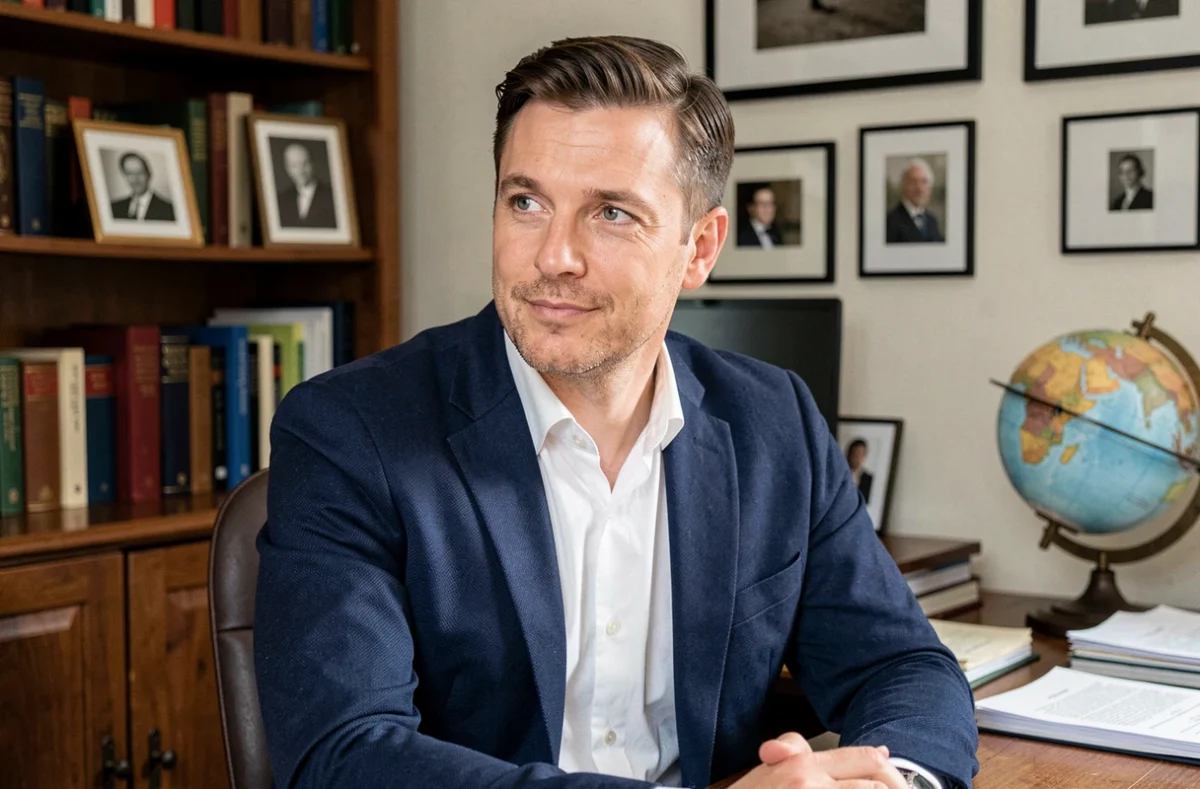
Matthieu Hocque is the deputy director of studies at the think tank Le Millénaire. His name circulates in searches related to family origins and private life, but verifiable public sources document neither. What is documented, however, are his positions on international politics, terrorism, and European security flaws.
Matthieu Hocque at Le Millénaire: a position that shapes his analyses of international politics
Le Millénaire is a French think tank focused on public policies and the debate of ideas. Matthieu Hocque serves as the deputy director of studies, a role that goes beyond administrative management.
This position grants him editorial legitimacy on the published works. He co-signs analyses of international politics with other researchers from Le Millénaire, which places his contributions within a collective framework rather than in the stance of an isolated editorialist.
The biography and private life of Matthieu Hocque generate frequent searches, but it is indeed his activity within this structure that fuels his media presence. A publication from the think tank dated October 11, 2026, confirms this role in the context of a work dedicated to the situation in the Middle East.
His responsibilities directly influence the choice of topics he addresses publicly. The deputy director of studies at a think tank must validate editorial angles, coordinate contributors, and present conclusions to the press. This is not a role of an observer.
Terrorism and European security: Matthieu Hocque’s columns in the French press
Matthieu Hocque regularly comments on terrorism and counter-terrorism policies. His columns in publications like Marianne address sensitive topics with a marked geopolitical lens.
In Marianne, a column published in September 2026 (updated in October) develops the thesis that European countries are paying for American strategic mistakes regarding terrorism. This framework links European vulnerability to decisions made across the Atlantic.
Why these topics rather than others
The choice of terrorism and security is not trivial for a think tank leader. These themes allow positioning in a field where media demand is high and where structured analyses often lack in the French public debate.
The columns signed by Matthieu Hocque do not limit themselves to domestic security. They systematically articulate the national dimension with international dynamics, which distinguishes his approach from a mere commentary on current events.
Matthieu Hocque and the Middle East: co-signed analyses in a complex geopolitical landscape
Among the identifiable works, a publication from Le Millénaire titled “Benjamin Netanyahu, towards the fall?” illustrates the thematic scope covered. This type of co-signed production engages the think tank in geopolitical areas where analytical rigor is tested by real-time facts.
Addressing the Middle East from a French think tank requires navigating several constraints:
- Limited access to primary sources on the ground, which forces reliance on open data and comparative analyses
- The necessity to produce an interpretative framework distinct from that of major Anglo-Saxon institutes, which dominate the field
- The risk of media simplification, which pushes to condense nuanced analyses into formulas usable by the press
The fact that Matthieu Hocque co-signs these works rather than publishing them alone indicates a collegial functioning. This mode of production is common in structured think tanks, but it deserves to be highlighted: the collective signature dilutes the individual expert’s stance in favor of institutional credibility.

Professional background of Matthieu Hocque: what verifiable sources document
Competing articles mention stints at Orange, Crédit Agricole CIB, and Capgemini. If these professional steps are accurate, they outline a hybrid profile between consulting, structured finance, and strategic analysis.
At Orange, the work reportedly focused on mobile payment models in Africa. At Crédit Agricole CIB, it involved structured financing and risk assessment. These experiences, prior to his position at Le Millénaire, explain an ability to address complex economic topics with an analytical toolkit that exceeds classic political commentary.
A profile that is not limited to the “public intellectual” category
The background of Matthieu Hocque blends the private sector with engagement in the debate of ideas. This dual experience is not common in the landscape of French think tanks, where profiles are often either academic or from high administration.
The trajectory from consulting to a leadership position in a think tank suggests a deliberate transition towards intellectual influence, with an operational background that few members of comparable structures can claim.
Origins and private life of Matthieu Hocque: the limits of what can be asserted
Search queries like “Matthieu Hocque origin parents” or “Matthieu Hocque private life” generate a significant volume of research. The content available online does not provide substantiated facts on these topics.
No reliable public source documents his family origins or personal life. Articles claiming to answer these questions recycle vague or speculative formulations.
This observation is not exceptional. Most leaders of French think tanks do not receive detailed biographical coverage. The curiosity of internet users exceeds what sources allow to assert rigorously.
We note that public interest in Matthieu Hocque’s private life contrasts with the density of his accessible intellectual production. His columns, co-signed analyses, and media appearances constitute a corpus far more exploitable than speculations about his origins. It is through this corpus that his influence in the French public debate is measured concretely.