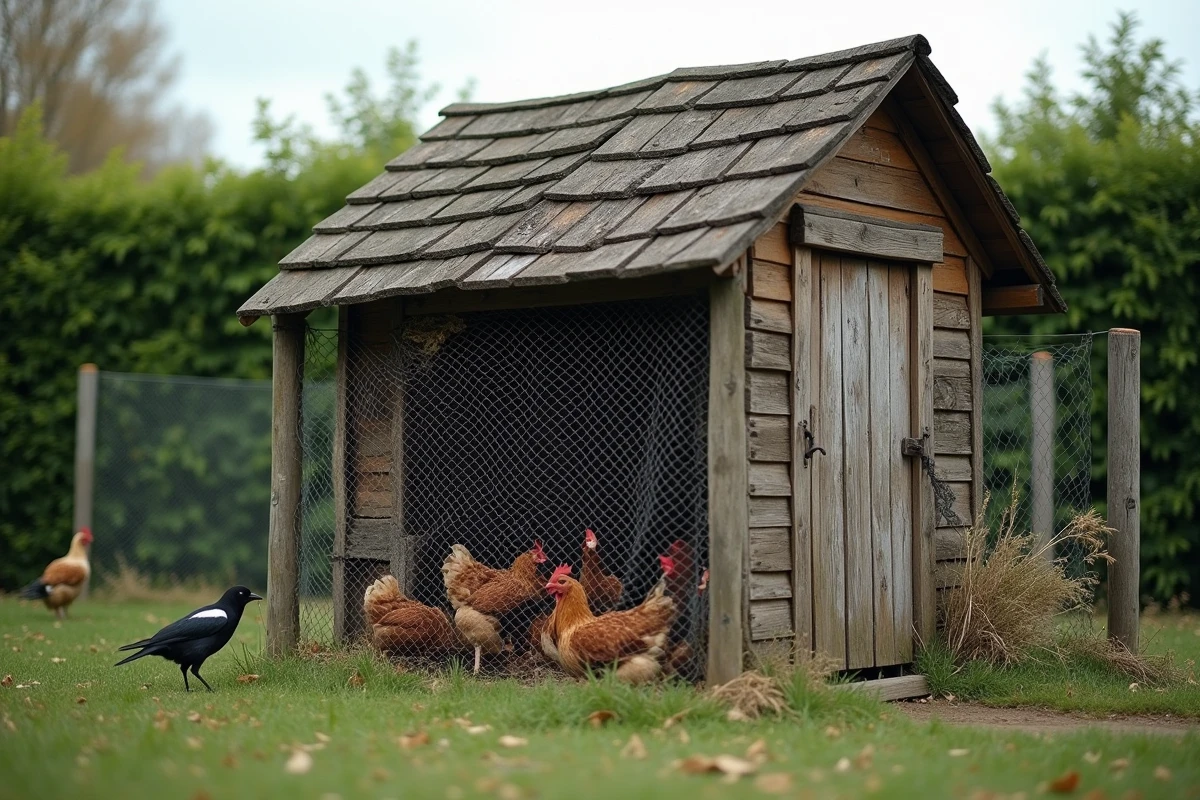
When you find empty shells at the foot of the nesting boxes every morning, doubt doesn’t last long. Magpies identify an unprotected chicken coop within a few days and systematically return as long as access remains easy. Protecting your chicken coop from magpies requires targeted interventions on the structure, the immediate environment, and feeding habits.
Bird nets and mesh: the only reliable physical barrier against magpies
Olfactory repellents (naphthalene, spices, white vinegar) are among the first attempts. They are recommended everywhere, but field reports are clear: magpies accustomed to a site ignore the smells within a few days. Breeders in Brittany surveyed by the Federation of Poultry of France in its April 2026 bulletin confirm this limitation and instead point towards bird nets.
To understand how to keep magpies away from the chicken coop sustainably, the first action remains to completely cover the enclosure with a fine mesh net. The Eurasian magpie can easily pass through a wide mesh intended for foxes. A sufficiently tight mesh is needed to block a bird the size of a pigeon.
Securing the stretched net above the outdoor run, with stakes or hoops, also prevents magpies from landing to observe the nesting boxes from above the fence. If the net touches the ground in places, corvids quickly learn to slip underneath. A well-stretched net with no contact points on the ground eliminates the majority of intrusions.

Urban chicken coop: adapting protection to magpies that proliferate near trash bins
In cities and dense suburbs, magpies do not rely on fields for food. They exploit household waste, outdoor cat bowls, and open composters. Their population density is often higher there than in rural areas, and they are significantly less wary of human presence.
Classic guides assume that the chicken coop is located in an isolated garden, surrounded by hedges. In an urban context, the situation changes on three concrete points:
- Magpies nest in the immediate vicinity (street trees, flat roofs) and patrol the neighborhood several times a day, which reduces the time between the discovery of the chicken coop and the first predations on the eggs.
- Visual deterrents (suspended CDs, reflective ribbons, silhouettes of birds of prey) lose their effectiveness more quickly because urban magpies are accustomed to the movement and reflections of vehicles, shop windows, and signs.
- Close neighbors complicate the use of sound or ultrasonic devices, limiting options to physical barriers and managing accessible food sources.
Eliminating any food source around the chicken coop is the priority in urban areas. This refers to the hen feeder left uncovered, but also to meal scraps in an open composter, or a cat bowl on the neighboring terrace. A magpie that finds easy food within a few dozen meters will return to explore every corner, including the chicken coop.
Ultrasonics and deterrents: what really works against Eurasian magpies
Ultrasonic devices deserve attention. A preliminary report from INRAE published in February 2026 on acoustic repellents for corvids indicates that Eurasian magpies are more sensitive to ultrasound than crows. For breeders cohabiting with several species of corvids, this distinction changes the choice of equipment.
An ultrasonic device with a motion detector, aimed at the main approach area (the top of the fence, a nearby tree), disrupts the magpie during its scouting. Feedback varies on this point depending on the terrain configuration and the distance between the device and the usual observation posts of the magpies.
Combining methods for a sustainable result
No isolated device solves the problem in the long term. The magpie is an intelligent corvid, capable of adapting its behavior within a few weeks. The combination that yields the best results relies on three simultaneous axes:
- Complete physical barrier (net or fine mesh covering the enclosure and run), regularly checked for holes or sagging.
- Removal of accessible food sources within a wide perimeter around the chicken coop: closed feeder or brought in at night, eggs collected at least twice a day.
- Complementary deterrent device (motion-detecting ultrasound or mobile deterrent repositioned weekly) to maintain a surprise effect.
Collecting eggs early and often remains the simplest and most effective action. A magpie that finds nothing to steal during several consecutive visits will eventually look elsewhere. Combined with a fully covered enclosure, this daily reflex is sufficient in most configurations.
Closed nesting boxes and chicken coop adjustments against egg theft by magpies
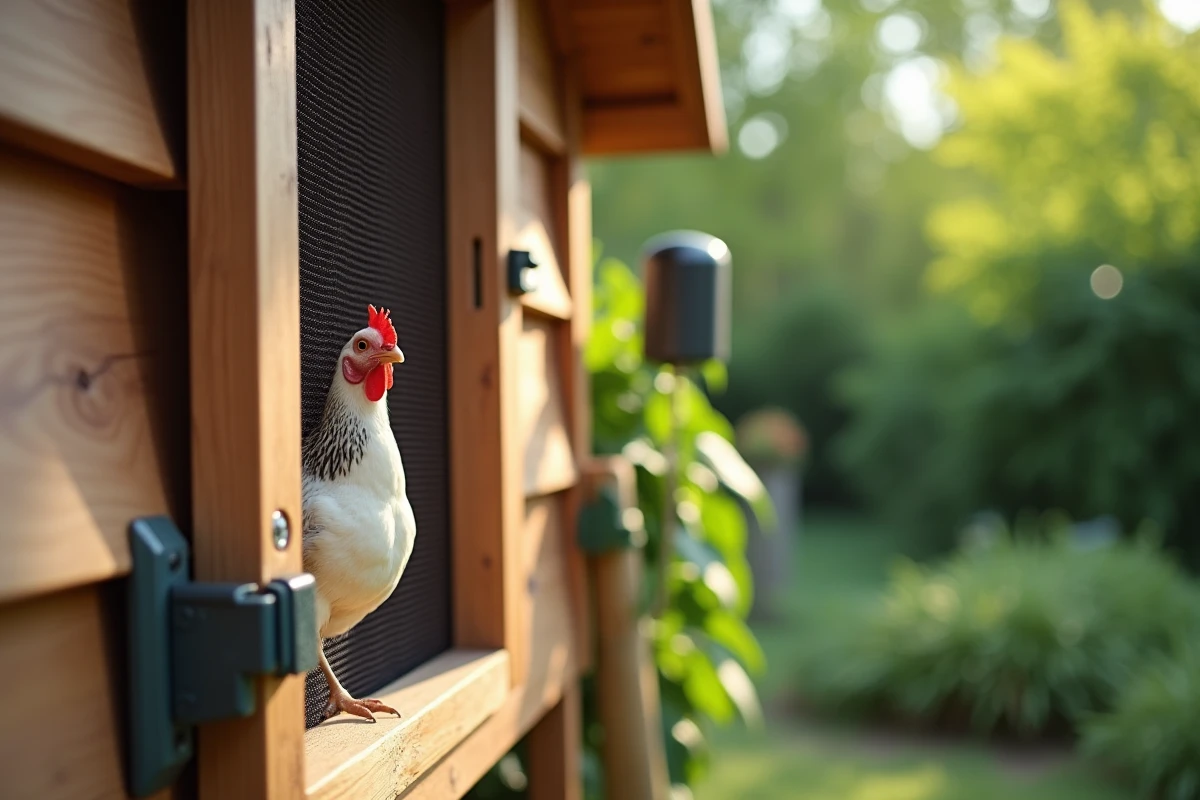
Even with a net over the run, the structure of the chicken coop itself can facilitate the work of magpies. An open nesting box on top or accessible through a wide door left ajar is an invitation.
Nesting boxes with a trapdoor, where the hen enters through a narrow passage, complicate access for a bird the size of a magpie. You can also install a curtain of plastic strips at the entrance of the nesting box: the hen gets used to it in a few days, but the magpie hesitates to cross an opaque barrier.
Closing the chicken coop during the day when the hens are in the run eliminates direct access to the nesting boxes. This habit assumes that the hens have laid in the morning, which corresponds to the natural rhythm of most laying breeds.
Magpies test every weakness of an installation. A properly stretched net, difficult-to-access nesting boxes, quickly collected eggs, and the absence of easy food nearby form a coherent set. Removing just one of these elements leaves an open door that magpies will find.